
What is the entourage effect?
What happens when CBD meets other cannabis compounds, and can that amplify its effects or change its action? In this section of Gorilla Grillz’ complete CBD guide, we tell you all about the so-called entourage effect and its impact.Content
How the entourage effect works Potential applications of the entourage effect Differences between complete extracts and isolated compounds History of entourage effect research Conclusion: An evolving field with many possibilities References
How does the entourage effect work?
In music, each instrument on its own may sound beautiful, but together they create an orchestra that is capable of playing entire symphonies. Something similar happens with cannabis. The entourage effect refers to the synergy that arises when several compounds present in the plant act together. Instead of thinking of THC or CBD as individual protagonists, this perspective invites us to observe how the sum of several components generates a broader and more diverse response than the action of just one. This phenomenon could explain why certain cannabis strains have different effects, even when they share similar levels of THC or CBD. The reason lies in the different chemotypes, that is, unique chemical profiles in each plant, which combine cannabinoids, terpenes and flavonoids in different proportions (Sainz Cort, 2024).Compounds involved in the entourage effect
 Cannabinoids are the best known compounds in cannabis. THC (tetrahydrocannabinol) and CBD (cannabidiol) have been extensively studied for their interaction with the endocannabinoid system, but they are not alone. Other cannabinoids such as CBG, CBC or CBN, to name just a few of the best known, also participate in this natural symphony. Each one brings its own particularities, and the most interesting thing is that several studies have found that they could influence how the others act, as we will see below.
 Terpenes, meanwhile, are responsible for the characteristic aroma of cannabis, but they not only provide odor: they can also have direct effects on the body. For example, myrcene has been linked to feelings of relaxation; limonene to higher moods; and pinene to mental clarity. These molecules can interact with cannabinoids to change how the same compound is experienced, making it milder, more stable, or even modulating its duration or intensity (Sainz Cort, 2024).
Potential applications of the entourage effect
Interest in the entourage effect does not remain theoretical. Gradually, research has begun to document how this interaction between cannabis compounds can have a concrete impact on different wellness scenarios. Below, we review some of the contexts where promising results have been observed.Inflammation and immune system
The immune system and its inflammatory responses have also received attention in this field. Some terpenes have shown affinity for the CB2 receptor, which is related to the modulation of inflammatory processes. Some cannabinoids such as CBD or CBN also interact with these receptors. The sum of these effects would imply that certain chemical profiles could contribute to reduce inflammation without causing alterations in perception or mental state. Myrcene and limonene, for example, have been studied for their effects on the inflammatory response, especially when acting together with cannabinoids such as CBD or THC (Voicu et al., 2019).Pain and emotional regulation
Several studies have explored how the combination of compounds in cannabis can offer a more comprehensive response in contexts such as persistent pain or emotional imbalances. Russo (2019) compiled evidence in which it was observed that patients using CBD-rich extracts obtained similar or even superior results to isolated CBD, but at lower doses. These types of formulations, moreover, tend to be better tolerated, which opens up the possibility of improved well-being less risk of unwanted effects.Applications in more complex conditions
Beyond common symptoms, science has begun to look toward more complex horizons. One of the most studied medical applications of cannabis in general is epilepsy, and some research has pointed to more potent benefits in its treatment by mixing multiple cannabinoids (Russo, 2019). On the other hand, research with cells and animal models, it has been observed that combinations such as THC, THCA and CBG could have promising effects on certain types of tumor cells, such as those of breast cancer (Russo, 2019). And in the field of neurodegenerative diseases, combinations with antioxidant and anti-inflammatory properties point to possible benefits in the management of processes such as cognitive impairment or prolonged oxidative stress.
Although there are no conclusive clinical applications yet, these findings open a door to future strategies that take advantage of the natural collaboration between compounds.
Differences between complete extracts and isolated compounds
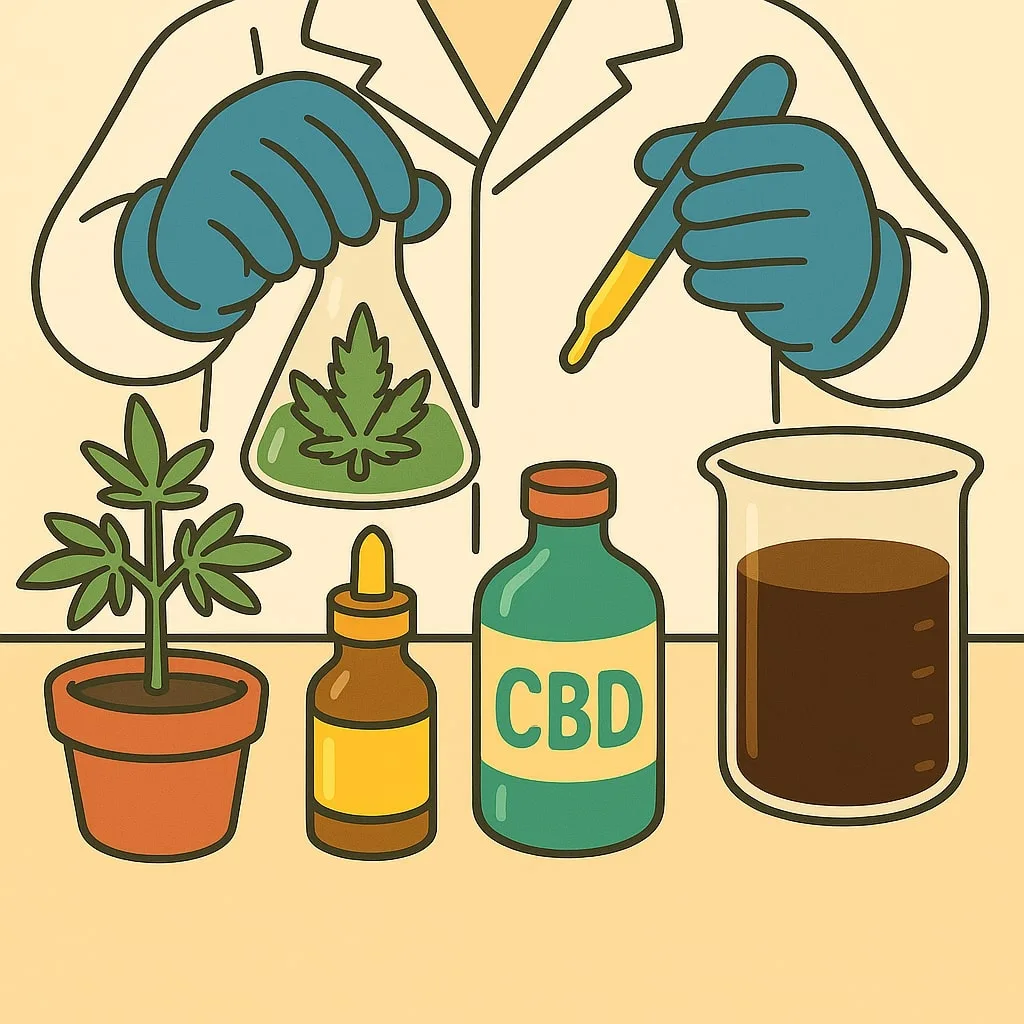
One of the big questions about cannabis is whether to focus on a single compound or to take advantage of all the natural complexity of the plant. This question has prompted numerous comparative studies. In many of them, full-spectrum extracts, which preserve major and minor cannabinoids, as well as terpenes and other compounds, have shown clear advantages over formulations with isolated compounds. For example, it has been observed that those who use complete extracts can achieve similar or even better results using lower doses. This not only represents a possible greater efficiency, but could also reduce the frequency of unwanted effects, since it avoids forcing the organism with high amounts of a single molecule. Furthermore, in comparative studies, those who used extracts showed a lower frequency of adverse effects (Marinotti & Sarill, 2020).These data point to the fact that secondary elements in the extract, such as terpenes or flavonoids, not only provide value in their own right, but may be facilitating a synergy that optimizes the effect of CBD. Taken together, this evidence strengthens the idea that the entourage effect is not just an interesting theory, but a functional principle with practical implications for how these products are designed and used.
However, that doesn’t mean that isolated cannabinoids don’t have their place. In fact, some studies have shown that pure compounds may be more effective in certain contexts. For example, in an analysis on lymphocyte activation, isolated cannabinoids such as CBD and THC showed greater inhibitory potency compared to their counterparts in plant extracts (Marinotti and Sarill, 2020). In addition, for some people, avoiding compounds such as THC altogether may be a priority for personal, legal, or health reasons. In these cases, working with isolates offers a distinct advantage: the ability to control precisely what enters the body, minimizing risks and maintaining a personalized approach.
Anti-inflammatory CBD CBD for topical use How cbd acts in the brain
History of entourage effect research
ORIGIN OF THE TERM
The idea that various compounds can work together is not new. In 1998, researchers Raphael Mechoulam and Shimon Ben-Shabat noticed that certain of the body’s own metabolites, while not active on their own, could amplify the effects of other endocannabinoids such as anandamide. They called this phenomenon the “entourage effect,” and proposed that it could be key to understanding why whole botanical preparations, such as those derived from cannabis, seemed to work better than their isolated versions (Ben-Shabat et al., 1998; Russo, 2019). Some time later, physician and researcher Ethan Russo took up this idea and applied it to plant-based cannabis. In his 2011 review, he argued that cannabinoids and terpenes could interact in ways that affected both perceived benefits and side effects. He mentioned, for example, how CBD can reduce anxiety caused by THC, or how pinene could help preserve memory in the face of the effects of THC itself. He also brought to the table caryophyllene, a terpene with an affinity for the body’s CB2 receptors, which are related to inflammatory processes. These observations helped to cement the importance of preserving the chemical richness of cannabis when used for wellness purposes (Russo, 2011).Evidence and evolution of the debate
In the following years, several studies began to compare full-spectrum extracts, i.e. those that maintain a variety of natural compounds of the plant, with formulations containing only an isolated cannabinoid. In several of these works, the more complete extracts showed better results or caused less discomfort, which reinforced the entourage effect hypothesis (Russo, 2019). However, not all researchers agree. Some reviews point out that the mechanisms behind these interactions still need to be better understood. Christensen et al. (2023) and Cogan (2020) agree that the term “entourage effect” has been used too loosely, and suggest that it is preferable to use more rigorous language from pharmacology to describe these combinations (Sainz-Cort, 2024). Even with this debate, authors like Russo maintain a clear position: retaining the natural complexity of cannabis can make a significant difference in its impact. And even if the underlying mechanisms are debatable, even authors like Christensen who oppose the idea of an “entourage effect” acknowledge that combinations may have synergies and interactions that would be worth investigating further to determine the mechanisms by which they operate.
Conclusion: An evolving field with many possibilities
It is important to remember that many of the studies on cannabis are still quite recent. For a long time, the in-depth study of this plant was limited by legal and social barriers, as well as the availability of some of the plant’s compounds. Today, with new scientific tools, cultivation techniques and a more open acceptance framework, it is possible to explore in more detail the interaction between its compounds and their impact in different contexts. Although there is still a long way to go, interest in these combinations is growing. Recent advances not only open doors to knowledge, but also to a more balanced approach: one that respects the natural complexity of the plant, while still valuing the precision offered by isolated compounds. In this search for a balance between diversity and control, many of the opportunities that will shape the future of cannabis are emerging.REFERENCES
- Ben-Shabat, S., Fride, E., Sheskin, T., Tamiri, T., Rhee, M. H., Vogel, Z., Bisogno, T., De Petrocellis, L., Di Marzo, V., & Mechoulam, R. (1998). An entourage effect: inactive endogenous fatty acid glycerol esters enhance 2-arachidonoyl-glycerol cannabinoid activity. European journal of pharmacology, 353(1), 23-31. https://doi.org/10.1016/s0014-2999(98)00392-6
- Christensen, C., Rose, M., Cornett, C., & Allesø, M. (2023). Decoding the Postulated Entourage Effect of Medicinal Cannabis: What It Is and What It Isn’t. Biomedicines, 11(8), 2323. https://doi.org/10.3390/biomedicines11082323
- Marinotti, O. & Sarill, M. (2020) Differentiating Full-Spectrum Hemp Extracts from CBD Isolates: Implications for Policy, Safety and Science, Journal of Dietary. Supplements, DOI: 10.1080/19390211.2020.1776806
- Russo E. B. (2011). Taming THC: potential cannabis synergy and phytocannabinoid-terpenoid entourage effects. British journal of pharmacology, 163(7), 1344-1364. https://doi.org/10.1111/j.1476-5381.2011.01238.x
- Voicu, V., Brehar, F.-M., Toader, C., Covache-Busuioc, R.-A., Corlatescu, A. D., Bordeianu, A., Costin, H. P., Bratu, B.-G., Glavan, L.-A., & Ciurea, A. V. (2023). Cannabinoids in Medicine: A Multifaceted Exploration of Types, Therapeutic Applications, and Emerging Opportunities in Neurodegenerative Diseases and Cancer Therapy. Biomolecules, 13(9), 1388. https://doi.org/10.3390/biom13091388.
- Sainz-Cort, A. (2024) What is the entourage effect. Gorilla Grillz blog. Available at https://www.gorillagrillz.com/efecto-sequito/